AgricultureNational
UGANDA: FROM REFORMING MINDSET CRIMINAL TO REFORMED CITIZENS (RTD), PRISON COMMISSIONER OKELLO ALLAN TO CLIMATE-SMART COFFEE FARMING

I thought to myself, I should have a country home in pre-urban Gulu City. In 2009, I bought 15 acres of land in Angaba Village, Koro Sub County, Omoro District. And all that began with planting Tick trees, and in 2017 I planted 5 acres of Coffee. I\
In a year, you are sure of the amount of money. At the age of your retirement, about UGX 20 million I get coffee is the way to go. The market is ready; you don’t go to look for the market. Whether you are sleeping in your bedroom, the market looks for you. So, my encouragement to the Acholi community is to grow Coffee.
OMORO DISTRICT- TUESDAY SEPTEMBER 8, 2026
By Okumu Livingstone Langol, (Uganda Correspondent)
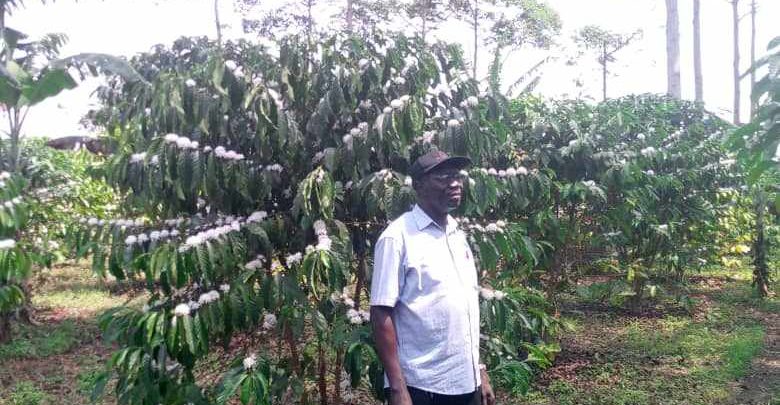
Okello Allan, 68 years old. The farmer of five acres of coffee in a land he acquired in 2009 has a story to tell. He has been a senior Prison officer for a long since 1983, working for 34 years. He retired from service in 2017 now a happy coffee farmer.
His narratives speak by itself after training school, he has been in the field as senior management being officer in-charge of the district and later services command in the Region. During his services he was able to move all parts of Uganda at various ranks from cadet ASP up to Commissioner of Prison when he retired from the services.
“I have been able to interact with people culturally, economically and administratively in those periods, and I have enjoyed my work with Uganda Prison services, I have no regrets. But working in all those areas gives me a lot of exposure, especially in the area of economic and social life exposure. We really did, and I gained a lot of friendships.
I have friends in each town and city in Uganda. I worked in a prison in the district, and in the farms working in the district gave me networking with government civil servants.
My Work in the farms exposed me to economic activities correctly, I was able to reform prisoners from the original mindset they had to more reformed citizens. We were able to work in the various farms and produce a lot of Agricultural products which we used to domestic consumption prisoners for sales to the government public and regional prison commanders in Mid-Western, Western and Northern Uganda.” Okello Allan stressed.
I worked, and I retired into business. I am running Hotel and Hospitality management as a business, and I also retired and still carry on as a commercial coffee farmer in Omoro District, where I am settled. I chose to go into coffee farming as part of my retirement activity for my survival after retiring from civil service.
My wife is a graduate teacher; she has been Head Mistress in Gulu City. We have been in coffee farming and she was in Gulu City. We have been in coffee farming for the last 10 years. After leaving Prison services, our choices, me and my wife for going for coffee farming have been of the experienced I again as prison officer, I choices to go into Coffee because it is perennial crops compare to other crops which is seasonal.
Coffee is not labour intensive; it is also good for exercise for older persons. All in all, when I go into the farm, I move and check. I find that I have moved not less than three kilometers a day, which is very good for my age of 68 years.
And I advise other older persons that, when they still have time, they should engage in economic activities like coffee plantation; when you have money, it’s very difficult to age poorly. In fact, the beauty of coffee is that you don’t weed; we slash it often.
Okello Allan, was supervisor at regional level where he was in-charge of those Prison farms, he has been a seasonal farmer, argued that he can be a good reformist, because he made so many people reformed, and also, he has been a good administrator where I have been working, he made a good impressive impact that changed the life and society at large. Before retiring, he prepared himself to retire.
The top management of Uganda Prison Farms brought home an expert.
There is no hand weeding or tilting of land in traditional methods with hoes; we usually used rotary grass-cutting machines; we used slasher machines.
And while harvesting coffee is not hard, when the berries are ripe, they become very soft to remove once they are ripe. Although some people may think it is extensive, it is not; I employed two or three workers during the harvest, and we sometimes joined them in the coffee harvest as part of farm activity.
Okello Allan implored that at the peak harvest, 2-3 people can harvest up to 200 kilograms per day, the harvest period is almost one and half months, because the coffee flowered at the same time. Coffee is harvested once a year; it also flowers once a year.
After harvesting, we clean the garden, we prune to allow the crops to grow before another circle of flowering to occur and this happens around January and February of the year as other wild trees flowering during the dry season.
After harvest, the coffee dries, and we sell it; we don’t process what is ordinarily known as KIBOKO. And usually, a kilo of coffee goes for about UGX 6,000 at peak period; I got about 70-80 bags that weigh 60 kilograms per bag.
In a year, you are sure of that amount of money; at the age of your retirement, about UGX 20 million, coffee is the way to go, the market is ready; you don’t go and look for the market.
“Whether you are sleeping in your bedroom, the market looks for you. So, my encouraging words to the Acholi community: let’s plant coffee, we will not go wrong, Omoro district is the largest coffee growing area in Acholi Sub Region.”
Angaba village, Koro Sub County, Omoro District. I just travel 20-40 minutes by car to Angaba.
What are your future programs?
After retiring at the age of 60 years old, and now I am 68 years old, what do I need? I live on five acres of coffee plantation. I don’t need to plant other things, because under my coffee trees, I keep some chicken and goats. Is not late; I planted Teak trees in 2016, before I retired.
Challenges
The challenges I am facing in my Angaba coffee plantation are water, although I have a borehole which I have in the farm, I used Motorola Hydraulics system to pump water. But water is a big challenge not only for me, but even to other coffee farmers.
The second challenge is labour: getting people to employ on a permanent basis; we rely on casual labour. Thirdly, transporting coffee from the farm to the market requires good transportation; other challenges are the poor telecommunication network in Angaba because of network problems in the area too.
However, the fire line is not a problem; we always planned for the fire line to avoid heavy losses.
The issue of agricultural inputs, Agro chemicals for fight and pest and diseases. Like fertilisers and chemicals like fertilizer and fungicides. They are not very easily available in the market; we have to look for them.
My advice to the Government of Uganda: they need to invest money for labour to subsidise input for coffee farmers in Acholi Sub Region.
Agricultural extension workers
We have enough Agricultural officer extension workers that keep on visiting my own coffee farm; they keep visiting us from time to time, which is good for us coffee farmers.
Okello Allan is a family member of 5 children, four boys and one girl, they are all doing okay, they are now living on their own things.
“From 1984, when I was in Training prison school, I got a wife; now we are 38 years in marriage.
Ojok Denis, Agricultural Officer In-charge of Labora Sub County, but overseeing Lakwana and Lakwaya Sub counties confirmed that the Omoro District is one of the largest coffee growers in Acholi Sub Region, although is very optimistic that he did not have the data for Acholi Sub Region of the coffee production.
“What I can confirm is that from Zone A, that is from April to July in the three sub-counties of Labora, Lakwana and Lakwaya, we have 100 coffee farmers, whose coffee plantations have survived 49-50 per cent. But those who have planted their coffee in the late season, in the month of July to August their coffee plantation dried up. Those people planted early, but those who planted late lost almost 90 percent.
The Agricultural Officer advises the coffee farmers, right now we are advising them to use mulching watery at least once a week, there will best to many coffee farmers they need to take our advice. Well, it is true that with the current weather, we need water production in such areas of intervention.
The government is planning for irrigation and improved soil by giving them fertiliser. On transportation he emphasized that coffee farmers in Omoro or Acholi Sub Region should form Cooperative Society, come together and form Cooperative where there they have bulking coffee production.
We are working around the clock to make sure that coffee farmers come together as a working group; transport will not be a problem.
On climatic smart Agriculture that is being practiced by Okello Allan in Angaba village, Ojok Denis advises that he needs to access his coffee farm to ascertain the quality and quantity water production which is being pumped to supply water to the coffee.
“On Climate Smart Agriculture production, I would only advise him when I visit his coffee production farm”, Ojok Denis said, concerned.