
National
UGANDA: NORTHERN UGANDA’S POST CONFLICT CONDITION, PROF. KOMAKECH DANIEL
to forms of social disruption

UGANDA: NORTHERN UGANDA’S POSUGANDA: NORTHERN UGANDA’S POST CONFLICT CONDITION, PROF. KOMAKECH DANIEL
This State of Northern Uganda, critically examines the trajectory of post-conflict reconstruction in Northern Uganda through the framework of transitionally, challenging the conventional assumption that societies move linearly from Conflict → Recovery → Development. Drawing on evidence from major recovery interventions, including the Peace, Recovery and Development Plan (PRDP I–III) and the Northern Uganda Social Action Fund (NUSAF I–III), the study argues that many communities experienced a cyclical pattern better characterised as Conflict → Recovery → Recovery → Recovery.
Rather than serving as a temporary bridge to sustainable development, recovery became a prolonged and self-reproducing condition marked by repeated rehabilitation programmes, aid-funded projects, and short-term livelihood support. While these interventions generated important gains in infrastructure, social services, and household welfare, they often failed to address deeper structural constraints related to economic transformation. Consequently, Northern Uganda entered what may be described as a “permanent recovery syndrome”, where recovery ceased to be a transitional phase and instead became permanently re-produced. This State of Northern Uganda, argues for a shift from Recovery to sustainable Transformation genuine developmental transition.
GULU CITY-WEDNESDAY JULY 8,2026
By Okumu Livingstone Langol, (Uganda Correspondent)
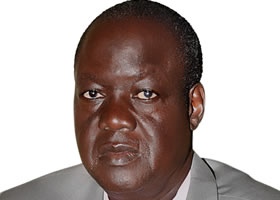
The research was carried out by Prof. Daniel Komakech Director of Gulu University Research Directory
The verbatim account
Northern Uganda’s contemporary political economy must be understood as the sedimentation of a prolonged and deeply disruptive armed conflict between the Government of Uganda and the Lord’s Resistance Army (LRA), led by Joseph Kony. This conflict, spanning more than two decades, constituted not only a military confrontation but also a profound reconfiguration of social life, spatial organization, and economic production in the region. At its peak, the war displaced approximately 1.8 million people into internally displaced persons (IDP) camps, effectively producing one of the most extensive systems of forced displacement in Sub-Saharan Africa. The significance of this condition lies not merely in the scale of humanitarian suffering but in the structural transformation of everyday life, where survival became dependent on militarized protection, humanitarian aid, and constrained mobility.
Dolan (2009) conceptualizes this historical conjuncture as “social torture,” a formulation that captures the depth of systemic suffering beyond physical violence. He argues that:
“Displacement became a system of structured suffering that extended beyond physical insecurity into the destruction of social existence” (Dolan, 2009, p. 57).
This is analytically significant because it shifts the understanding of conflict from episodic violence to forms of social disruption. In this sense, the war did not only destroy infrastructure and livelihoods; it dismantled the relational fabric of the society, including kinship networks, customary governance systems.
And agricultural cycles that had historically anchored Acholi and broader Northern Ugandan societies. Consequently, the post-conflict condition cannot be interpreted as a simple return to pre-war normalcy but rather as the emergence of a new social formation shaped by rupture, dependency, and adaptive reconstruction.
From a political economy perspective, this period restructured economic relations, spatial geography, and household economies. Agricultural production collapsed in many areas due to forced concentration in camps, leading to dependency on food aid and external humanitarian governance. Governance structures were simultaneously reconfigured, as the state extended its presence primarily through military mechanisms rather than civic institutions. Thus, the background condition of Northern Uganda is best understood as a multi-dimensional collapse of productive, social, and institutional systems, the effects of which continue to shape post-2006 recovery trajectories The Post-2006 Transition
The cessation of large-scale hostilities in 2006 marked a critical turning point in Northern Uganda’s historical trajectory. However, this transition must be interpreted cautiously, as the end of armed conflict did not automatically translate into structural recovery or social justice. While physical insecurity declined and IDP populations began returning to ancestral lands, the deeper institutional and economic conditions of fragility persisted.
Adam Branch offers a critical corrective to the narratives of post-conflict recovery, observing that:
“The end of war does not automatically translate into the end of political violence or structural inequality” (Branch, 2011, p. 201).
This insight is crucial for understanding Northern Uganda’s post-2006 condition. The transition period is characterized by what may be termed “post-conflict layering”,
where new developmental interventions are superimposed upon unresolved structural inequalities inherited from both the conflict and pre-conflict political economy. The return of populations from IDP camps did not coincide with full restoration of land rights, productive assets, or institutional capacity. Instead, recovery unfolded unevenly, shaped by variations in household resilience, access to land, social capital, and proximity to emerging urban centers.
Key transition activities such as; the reconstruction of physical infrastructure such as roads, schools, and health, and the proliferation of recovery programmes such as Northern Uganda Social Action Fund (NUSAF) and Peace, Recovery and Development Plan (PRDP), often operated within what scholars describe as a technical-development paradigm, emphasizing service delivery and infrastructure while under-addressing structural transformation of the economy.
In the section that follows, we look at NUSAF I-III and PRDP I-III, to think through this ‘technical development paradigm’, to strategically point to the problem of “reconstruction without resolution”. The idea here is not to trivialize the foundational contribution of the interventions, but rather, to elaborate on the entrapment with transitionally as opposed to structural transformation.
T CONFLICT CONDITION, PROF. KOMAKECH DANIEL