
AgricultureGlobal Politics
UGANDA: ACHOLI TRADITIONAL CULTURAL PRACTICES INTERTWINED WITH RELIGIOUS NORMS AMID PROLONGED DRY SPELL
“People have abandoned the ritual of rain making for greener pasture in western culture as it boomeranged with prolong dry spell

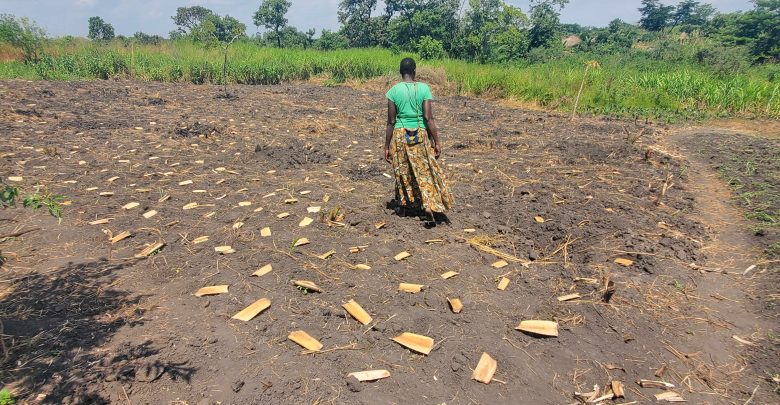
Photo By Okumu Livingstone Langol
The Acholi Ker Kwaro Puranga needs help with their royal regalia as drought is coming.
OMORO DISTRICT-MONDAY JULY 12, 2026
By Okumu Livingstone Langol, (Uganda Correspondent)
A trip from Gulu City to Idure village is 35 to 45 kilometers. I went to see Agulu Kot of Puranga chiefdom. This place is home to the rainmaker pot called Kirubi. On my way I saw malnourished crops.
The crops like Cassava, groundnut, Soybeans, maize and beans were struggling. There have been some raindrops in Acholi Sub Region, in Gulu City. When I reached the home of the Pauline Okeny, the Traditional Rain Maker of Puranga I was disappointed. The remains of Agulu Kot hut is only its foundation remained. The wall and roof have been demolished. The only thing standing is a two-room construction with a white iron roof.
Okeny’s homestead is near Idure center. I met Oyere Okeny; his son was not there. His wife, a lady called Ajok was at home. She told me that everyone else had gone to the garden. I asked Ajok what happened to the rainmaker hut. She said the hut had collapsed and a new one had not been built. She pointed to a man, her father-in-law who might have the answers.
The old man lives in a hut. I could not reach him because the walkway was rough. I wanted to confirm if Puranga chiefdom still has a rainmaker. I saw that the old man was living in poverty. The people of Puranga chiefdom are struggling because of culture. How rainmaking started I read about how rainmaking began on
https://www.oyengyeng.com/uganda-puranga-chiefdom-unity-and-perform-ritual-traditional-rainmaking/
An elder called Opira Amollo explained that over 200 years ago a strange man came to Puranga chiefdom. The man had an ulcer on his leg. He looked for someone to treat his wound. No one was willing. The chief’s wife helped him. She cleaned his wound. He revealed that he had three stones that make rain. He performed a ritual. It rained heavily. The British colonial masters took the rainmaking stones in 1911.
They gave them back when there was a long dry spell. When I left Idure village I went to Lakim village. I saw crops turning from green to yellowish. The season was supposed to be for harvesting. The whole village has not had rain for months.
The crops are now animal feed. People are harvesting Groundnut by digging with hand hoes. Otema Nelson, 63 years old was harvesting his groundnut. He complained about the drought. The last heavy rain was in May.
Utema Nelson woe is depicted the thought of Acholi community who they are now suffered quietly, otherwise who will bail us, the issues this day, after the post LRA conflict, the younger generations do not know the cultural background, if in the past when drought threaten humanity, what can be done, do people fall their hand and watch in Abey. Where do we come from, those are the question that people should be asking, rather than believing in alien way of solving their problem.
Do Acholi people do they not have Philosophers in the past, what about now, do we not have rightful thinkers. Otema Nelson posed.
. I met Major Odong Bernard, the Omoro District Operation Wealth Creation representative. He is from the Kal Orimo clan. He promised to arrange for mediation between Kal Odokotaya and Kal Orimo. Major Odong was angry when he got the information concerning royal regalia If mediation fails, we will use force to reclaim regalia which is missing when Rwot Ochan Jimmy Luwala was installed as the rightful Rwot of Puranga . He questioned if the elders of Kal Orimo are aware of that, especially the clan leaders knew about the conflict. He warned that failure to resolve the conflict will lead to action.
According to Muzee Luke Orach, the Chairman of AOL community the clan elder of Bolo the conflict started in 2002 when the Puranga Chiefdom was removed from Kal Odokotaya. However, Latigo Yonacan, a Puranga elder said that Kal Odokotaya and Kal Orimo should mediate. Otherwise, Kal Odokotaya has all the regalia.
The attempt to contact Silvio Opobo, the chairman of Puranga rainmaking was not successful. But I read his 2022 response:
“People have abandoned the ritual of rain making ” Opira Amollo, the clan elder of Kal Odokotaya said they are ready, for peace dialogue. “All of us yearn to have rain and for us we can make rain only that we need peace co-existence.”
Ker Kwaro Puramaga was taken from Kal Orimo in the 18th Century. Rwot Ogwang Okok took over Rwot of Puranga from Rwot Cwinya Agara and later Okello Mwaka, the Gen. of Puranga chiefdom his children took over the realm of power. In 1914 when Gen Okello Mwaka was slain. The then British colonial government put his children replacing Rwot Ogwang Abwaong. Gen Okello Mwakas siblings were appointed to take charge of Puranga Aywee and Puranga Ogwita.
His son called Ochen Awaa, son of Okello Mwaka was appointed chief of Puranga Aywee. The area he oversees stretches from Awere to River Lukee, which’s about 9 miles from Patongo. On the hand Olal Adiri was appointed as Rwot Puranga Ogwita. His area of responsibility goes from Lalogi Sub-County to Koch Ongako.
The chiefdom of Puranga still has an issue. The royal drum of Ker Kwaro Puranga is still divided among two different clans who claimed the ownership, since they have the same equal power as Rowt Puranga of Bobi. In Acholi tradition the chief with the drum has the power to call for war.
Major Odong, a prince of Kal Orimo is worried about the conflict between Acholi traditions and Western religious beliefs. He says born- Christianity is affecting traditions. He gives the example of Kal Orimo, where young boys are important because the Abila shrine is not being taken care of.
Major Odong accuses Odong Ayaba of not taking care of the Abila shrine. He says Ayaba claims to be born but Jesus Christ, who started Christianity did not come to destroy culture.
“Ayaba is the person responsible for the Abila of Kal Orimo. He is hiding behind being born and refusing to perform traditional functions of Abila. This has affected youths. If he does not have a boy, it means all clan members must suffer his actions ” Major Odong said.
Okema Oyere, son of rainmaker Okeny Pauline claims to be born. He abandoned the function of Puranga rainmaking. This is why Acholi cultural traditions and Western religious norms are in conflict.
For a time, Acholi people believed in a worldview where the spiritual and physical worlds were connected. The Abila or ancestral shrine was at the center of this belief. It represented the presence of departed forefathers. Served as a place for reconciliation, justice and cultural continuity.
The arrival of Christianity changed this understanding. Born Again Christians believe that salvation comes through Jesus Christ. They reject mediation and ritual sacrifices. Many converts abandoned rituals and distanced themselves from ceremonies associated with the Abila.
This has created tension within Acholi families and communities. Elders regard the Abila as a symbol of cultural identity. However, many Born Again believers see participation in rituals as incompatible with their faith.
Despite these differences, culture and Christianity are not always mutually exclusive. Many Acholi cultural values can coexist with beliefs. The interaction between Abila and Born-Again Christianity shows that Acholi society continues to negotiate the balance between preserving its heritage and embracing Christian doctrine.
The notion that tree cutting is the cause of prolong dry spell is not true, because new tree is regenerating or where new trees have recently been planted
The Acholi Sub-region has undergone changes in its tree cover over the past two decades. Deforestation driven by charcoal production expansion of agricultural land and household demand for firewood has transformed large areas of the landscape. However, nature is gradually reclaiming spaces that were once stripped bare. Abandoned farmlands have begun to regenerate with young woodlands emerging where cultivation has ceased.
Indigenous tree species are steadily re-establishing themselves. This natural recovery has been reinforced by deliberate conservation efforts. Farmers are integrating trees into their farms through agroforestry. Communities are establishing woodlots of eucalyptus, teak and fruit trees. Government agencies, institutions and development partners have also intensified restoration initiatives.
The Acholi Cultural Institution working with the National Forestry Authority and other partners launched a campaign to raise and plant 40 million tree seedlings across the sub-region. This effort aims to restore landscapes and strengthen environmental resilience.
While Uganda loses tree cover each year these figures should be interpreted with caution. Annual tree-cover-loss datasets primarily record where trees have disappeared. They do not fully capture areas where forests are naturally regenerating or where new trees have recently been planted. The region presents a landscape in transition, where the scars of deforestation remain evident, but the emergence of millions of young trees offers renewed hope, for restoring Acholi’s woodland heritage.