
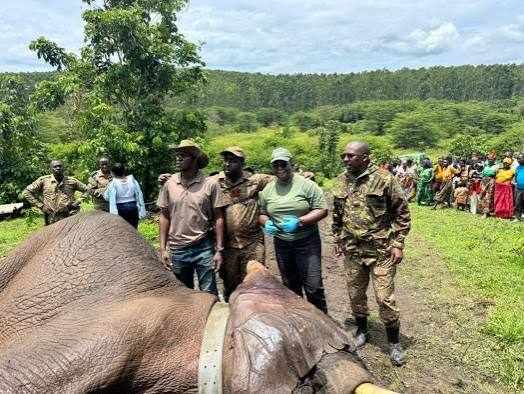

The coexistence with wildlife in Nwoya reflects both a tainted relationship and a renewed struggle for peacebuilding with the wild. Graveyards are common places; crop raids still stand as painful memories of people neighbouring the park, as both animals and people suffered casualties.
NWOYA DISTRICT-MONDAY OCTOBER 12,2026
By Okumu Langol Livingstone, (Uganda Correspondent)
As conflict raged on for decades, elephants, which carried out the largest raids in the area, also suffered; they, were trapped by wire snares and heavy metal traps, while some were speared; others were poisoned in what appeared to be a revenge-like activity.
Recently, as the elephants suffered, the people neighbouring the park are observing their memory, and intelligence like humans, which are helping them to survive, as they have become sensitive to pumpkins and pawpaw, the most common food crops, which have killed some of them in suspected poisoning.
For some members of the community, like Pyro Paul Nyeko, aged 86, both painful memories and guilt define their time, in what he called ‘elephants on poison’, which killed some. He claimed that, for a long time, some people would mix up food crops like pumpkin and pawpaw with poison.
“We used to put poison inside pawpaw and pumpkin; we cut pawpaw into two and placed chemicals, but these days, once they find pumpkins and pawpaw, they can’t eat them but throw them away. They now know what can kill them,” Nyeko stated, in what contradict Uganda wildlife conservation efforts.
For communities neighbouring Murchison Falls National Park in Nwoya, elephants often have incredible memories, but their cognitive abilities go far beyond simply never forgetting but one that is of the most sophisticated minds in the animal kingdom.
Like humans, the communities around the park have documented instances where the elephants would inspect the territory, smell the pumpkins dumped in the gardens for any suspected chemical reactions and fill the trenches in the buffer zone and radiate outside into community land for water and food.
As humans have a larger brain, it’s worth noting that the elephant brain contains as many neurons as a human brain, and while people have no idea of this fascinating fact, the human-like intelligence the elephants have developed to survive has amazed the community.
Before the raids, people have seen elephants gather together in what appears to be their planning moment, which is usually led by the one which earlier surveyed the route where food was discovered.
Along the way, people noticed that when one which earlier detected the food lost direction, the second elephant, which had smelled the food from the noise of the first, took over, and once the second one also lost track, the third picked up until they located the food through a shared memory.
Recently, Hilda Aya, aged 29, saw a group of elephants descend on her two acres of maize crop; they uprooted the crops but never ate from the gardens as Ayaa would nervously watch them from inside her grass-thatched house in Angung village. “They pulled them in front of my door”.
For decades, the people have seen the elephants feed on their crops in the garden, but Ayaa stayed with her giant neighbour from 9: 00 PM until 8: 00 AM “One stood at my door, blocking us inside. Others were eating what they had harvested, finished it and left us without harm,” Ayaa recalled.
“They used to come and terrorise the community, and when they are approaching the village, you can hear the grumble of their stomachs. They produce a sharp sound; you would know that the elephants are coming.” 70 Charles Nyeko acknowledged.
Nyeko had seen what he called ‘the head of elephant’, the one that moves quietly into the village and into the compound, surveying for food: “They tiptoe to your door steep, and you cannot detect the beast is around. It has detected what is inside the house”
Once the head of the elephant returned to the park, a large group would come, surround the house, remove the roof and eat crops from inside.” The head reports back, and they carry out targeted raids following the earlier reports”
He added, “The one that surveyed the home will stand at your door and block it; others concentrate on eating, and they will never disturb the next house if you don’t provoke them. We can’t sleep in the same house where crops are stored because that is their target”
Nyeko recalled how earlier interventions to drive elephants off, like blowing whistles, beating drums, jerrycans and empty tins, but would work, but have outlived their usefulness as the elephants have learnt them “Today they don’t run but become very aggressive when we use them”
And “once the elephants get into your gardens, they will eat everything, and you cannot even chase them; they eat and leave at will.”
“I was sleeping inside together with my 7 children, when the elephants came, they opened the roof of my house with maize stored in it, and pushed their hands inside all of my 5 bags of Maize.” Delphine Anek recalled in a recent interview. Her home was first surveyed by an elephant.
Within her neighbourhood, a similar raid occurred. Elephants pitched camp, pulled down a mango tree and blocked the path leading to her neighbor’s home and all the access routes to the garden before they uprooted her 2-acre maize crop.
When elephants attacked his soybean crop, Patrick Ojok attempted to drive them away by blowing a vuvuzela, but an elephant which earlier surveyed the area charged at him. He attempted to run but got surrounded by another elephant, although he survived without harm.
“I didn’t know how I thought about it, but I grabbed some grass and put it on my head and stood. They stopped coming towards me, looked at me for a few minutes and left,” Ojok narrated his ordeal of survival.
Like others, Ojok had watched elephants make their way into the community, although the Uganda Wildlife Authority has dug some trenches around the park buffer zone to protect the community from their raids.
“If they find trenches, they will dig soil and fill them up. Sometimes, they move through the trenches and find a narrow ending that allows them to jump up the community land,” Ojok observed.
The affected villages once used chaos and loud voices to repel the elephants, but as elephants adopted a new way of survival, Joyce Angeyo, aged 66, is learning to make peace with the elephants as she lowers her voice to communicate in times of crisis.
“When you shout at them, they will get wild, but when you talk in a low voice and beg, they leave”, Angeyo stated, equating elephants’ behaviours with humans’, as she had lived in peace with the wild beast for 66 years without physical harm.
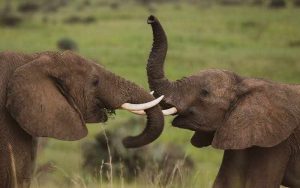
Elephants either theu are communicating serious things or planning to invade an area
File Photo
When a group of elephants visited her home, they divided themselves into three groups: one group had 7, the second group had 7, and the last had 2. Each attacked her house at once.
The rest of the people were sleeping, but once they sensed danger, each scrolled out quietly and watched the destruction of their maize crop some distance away “They were feasting on my maize, and I scrolled between the legs of two elephants and fled”, Angeyo wistfully looks back.
As wildlife conflict ends the lives of both animals and people neighbouring Murchison from the north, a group of volunteer community rangers are slowly changing the narratives in which the people can find peace with the wild.
Such volunteers include Francis Ojok, aged 36, who monitor the community lands and help to drive back elephants into protected areas. Such an initiative is helping change attitudes towards wildlife and restoring confidence in conservation through community participation.
Without scientific proof, Ojok observed that elephants share common intelligence traits with humans, which he says they can pass their memories for generations for over 500 years: “they can’t forget their route, and you have people who settled in those corridors”
Ojok still remembers the ‘Lutuk-Temo’ road, about 67 kilometres connecting Olwiyo to Koch Goma, the corridor once used by the elephants, which has been taken up by road development, but the elephants still pass through the same route as both humans and animals compete for space.
“The elephants still know that this was their route, and they have continued using it to come to the community. They haven’t lost that memory of this route, yet people have settled on and planted their crops. It’s difficult to control raids when they can’t forget their rout” Ojok added.
He is, however, hopeful that human-wildlife conflict in Nwoya will be a thing of the past once the Uganda Wildlife Authority completes installation of the electric fences around Murchison Falls National Park.
The Executive Director of Umoja Wildlife Conservancies of Uganda, Walter Odokorwot, noted that wildlife conservation should not only be left to the government, as community participation is key for coexistence and keeping that natural heritage for generations.
He urges that, in Countries like Kenya, the government has adopted conservancy approaches which empower local communities to manage wildlife on their private lands and generate livelihoods from, the approaches he observes are yet to be scaled up in Uganda.
As of 2026, regarding the state of wildlife resources in Uganda, the Uganda Wildlife Authority estimated the number of elephants to be 6,352 between 2023 and 2025, compared to 6,621 between 2021 and 2022, meaning the number of elephants decreased by 269, as reported’
The report revealed that as the elephant population declined in the period under review, some crossed into Kenya, where some of the collared elephants have been recorded on Earth-ranger. Other factors include poaching, land use change and expansion of infrastructure in conservation areas.
While graveyards are common in Nwoya with stagnated livelihoods, for now, a shared memory is restoring peace and slowly building up an ecosystem in which both humans and wildlife complement each other on shared land.