CulturesGlobal Politics
UGANDA: GROUP FARMING IN ACHOLI AND GRANARY METHODS IS HAUNTING AS HUNGER STRIKE

Today, the hunger exists in the land that once fed regions beyond itself. This is not because Acholi forgot how to farm, but because the architecture of its food system was broken
By Okumu Livingstone Langol, Our Correspondent
I am Alimo Palma, age 28, years, I am Market Vendor at Olaiylong Market in Gulu City dealing in produce, she sells Millet and other food item, recounted that food items start to waste from the garden, because traditionally our method of harvesting we do not have prepared means used for harvesting food stuffs.
“For example, Simsim get wasted right from the time of harvest, because we do not have enough space to contain simsim that fall aside. Acholi constructed a temporary structure for drying simsim from the garden to allow simsim to dry.”
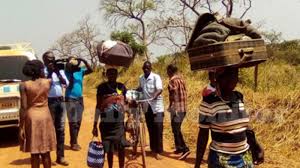
Acholi stable food crops, Sorghum, Millet, Cow peace are most common food stuff in Acholi Sub Region, as photo above being sold at Olaiylong Market in Gulu City.
Photo by Okumu Livingstone Langol
I am Oola Coocere, I am 75 years old, a business in Gulu City I hail from Adak village, Lakwaya Sub County, in the past, I observed that before the sun rose over Acholi in the late 1950s, the homestead was already awake. Smoke lifted gently from three-stone fires, and the sound of wooden pestles striking millet echoed across compounds like a quiet drumbeat announcing the day. In those years, hunger was not a daily anxiety. It was a rare visitor, kept at bay by a system older than colonial rule, older than roads, older than money. Every Acholi homestead was, in itself, a granary.
In that period, Acholi Sub-Region held an estimated population of between six hundred and fifty thousand and eight hundred thousand people. Families were large, often extended, averaging six to ten members per household, sometimes more in polygynous homes. Children were not dependents alone; they were labour, learners, and future custodians of land. The abundance of land matched the abundance of people. A household cultivated four to five acres without dispute, without surveyors, without title deeds. Land was not scarce enough to be fought over, and food was not uncertain enough to be hoarded selfishly.
Farming was never an individual affair. It was governed by custom, coordinated by the Rwot Kwidi, and disciplined by shame and belonging. When the dry season stretched on, men opened the land early in a practice known as Agree. Hoes broke the soil weeks before rain fell, allowing the earth to rest and drink when the clouds finally gathered. This was not called climate-smart agriculture then, but it worked exactly as such.
Eng. Jimmy Odwar, son of the late Owor Amac of the Puranga spiritual leader of Olan Teng deity also recalled that in the 1950 and 1960 when they were growing up. When the time came to cultivate in earnest, there were the labor forces that moved in rotation through what the Acholi called Aleya. At dawn, groups of men and women, sometimes more than thirty strong, gathered and walked together to one garden. That morning they would tilled Ojok’s field. And tomorrow, they would move to Opiyo’s. The next day, another household. No one worked alone, and no one was left behind. By midday, an entire acre could be prepared, something that today might take weeks for a single household struggling without labour or machinery.
“I was among the youth who took have communal labor force of Aleya, we could move from one garden to the other as we rotated digging until all members who form the groups cultivation is over as dig hundreds of filed in a months as time goes, in a day we could dig more than two acres of land, because the elderly people settle back home, we the youths we would go cultivates more areas of land.” Odwa Jimmy narrated.
I noted that planting followed the rhythm of rain and ritual. In places like Puranga Chiefdom, elders first sought the sanction of Olal Teng, the deity believed to guard cultivation. Millet seed was unveiled, mixed, and placed in a large bowl called Odero. Elders representing forty-four clans took seed as both blessing and responsibility. Only then did sowing begin, often before the first rain fell in mid-February. When the rain came, the seed was already waiting in the soil.
Millet dominated the fields, followed by sorghum and simsim. Maize was present but not yet king. These crops were chosen not for markets but for resilience. Even without fertilizer, traditional millet fields yielded between eight hundred and twelve hundred kilograms per hectare, sometimes more in good years. Sorghum performed just as reliably. Today, despite improved seed, many smallholders harvesting millet under rain-fed conditions struggle to exceed those same figures. The difference is not knowledge alone; it is timing, labour, and soil rest—things the old system protected.
By July, the harvest began. Women moved into the fields with small knives, cutting millet heads and placing them into Aduku baskets. Men and children ferried the harvest home. What followed was the most important stage of all: storage. Every homestead had at least one granary, raised from the ground, plastered with mud and cow dung, positioned carefully to avoid dampness and fire. Larger households maintained two or three.
The granary was sacred space. Women were its custodians. Men were forbidden from accessing it, not as punishment, but as protection. Control of food was control of survival, and Acholi culture placed that responsibility firmly in women’s hands. Grain was first stored to ferment lightly, then dried in the sun and returned to the granary. Properly managed, millet could last three to five years. Losses were minimal, often less than ten percent annually. Today, without granaries, post-harvest losses can swallow nearly a third of production.
Inside the homestead, food followed ritual and measure. Ms. Ajok would pound millet using Opam, winnow it through Kworo, and grind it at Rego Ikidi, kneeling over a smooth stone worn down by generations before her. Water was measured carefully, never guessed. The dough for kwon kal was mixed until aroma signaled readiness. Bread was shaped into round balls, portioned to feed the household evenly. No one ate alone, and no one ate more than their share.
A household cultivating five acres could harvest two to three tonnes of millet in a good season. With average consumption estimated at one hundred and fifty to two hundred kilograms per person per year, such a household could feed itself fully and still hold surplus. That surplus was not rushed to market. It remained in the granary, insurance against drought, illness, or obligation to kin. Markets were secondary. Survival came first.
According to Odong Mwaka, 97 years old, elder from Bobi Sub County Omoro District he revealed that by the early 1960s, Acholi supplied millet and sorghum to urban centres in southern Uganda. Colonial produce records noted northern Uganda’s contribution to internal grain flows. Yet this was not a commercial farming society in the modern sense. It was a storage-based food economy, one that measured wealth not by cash but by how long a granary could last.
Then the system began to fracture. Conflict, displacement, the collapse of communal labour, and the erosion of customary authority dismantled what had held the food system together. Granaries disappeared from homesteads. Farming became individual, labour scarce, planting late. Food security shifted from stored grain to cash purchase, exposing households to drought and price shocks.
Today, hunger exists in a land that once fed regions beyond itself. This is not because Acholi forgot how to farm, but because the architecture of its food system was broken.
What existed in the 1950s and 1960s was not primitive subsistence. It was a disciplined, collective, and sustainable system that balanced population, ecology, and culture. Its memory lives in elders, in stones worn smooth by grinding, and in the empty spaces where granaries once stood.
To remember it is not nostalgia. It is evidence that another way once worked, and could again.