Global Politics
UGANDA: THE OF “GATE OF PAGAK,” GATE OF NO RETURN, STAND A SEMBLEMENT STRUCTURE CATASTRPHY SLAVE TRADE IN PATIKO FORT
How the Arab slave trade became the monster, turned on their host Luo Gang/ Acholi of Patiko Chiefdom, which symbol of civilization at the time

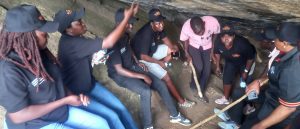
Photo By Wokorach Simon
Promoting Acholi tourism and Uganda tourism, a young and elegant spokesperson for the Ministry of Tourism, Wildlife, and Aquatic Resources, Ms. Eunice Tworekirwe, led the Uganda Media Club on a fact-finding mission to the abandoned slave trade hub in Acholi land, Fort Patiko. Story told from tomorrow.
GULU CITY-SATURDAY March, 14, 2026 Our Correspondent
On Saturday, March 14, the forgotten slave Hub in Acholi Sub Region was brought alive. Ronald Okello, local Guide at Fort Patiko, 16 kilometres North of Gulu City, his narrative was super revealing, gruesome human suffering in 18 centuries by the hand of the Arab slave trade in southern Africa.
In true Acholi cultural norms, sitting in a circle narrating matters, the hidden human suffering in Patiko chiefdom, it was Okello Ronald who was the Centre of attention of the day for over 40 journalists sitting in a small grass thatch in a circle, as it used to be when the Luo Gang, later named Acholi. The Public Relations Officer of the Ministry of Tourism, Wildlife and Aquatic, Ms. Eunice Tworekirwe, was among the media fraternity.
Attentively, Okello began his story in a moving Hollywood style. I am going to narrate an oral history of the Patiko chiefdom (the People), soft-spoken Okello, a tour guide, would be remembered later. I have two or three people who are my guides to be trained.
He asserted, by the way, on the 21st March, 2026. This year, we are going to have the sendoff funeral rite of our departed Rwot Bongjana to remember. We have the historical site, including the Luo of the Labongo and Gipir, where the conflict arose that led them to part ways.
When the Gipir developed a misunderstanding with his elder brother Labgono, resulting in their separation. Later on, when the climax of their conflict reached the point that the two brother can no longer share and live together, at bench of the River Nile, Gipir threw an Axe in the River Nile, which made the water stop and made a way to allow the groups of Gipir to match while crossing the River Nile.
They are now called the Alur of West Nile, the Alur of the Democratic Republic of the Congo, and the Alur of Cameroon.
The Labongo groups of people are the Acholi of South Sudan, Acholi of Northern Uganda, and the Padola of Eastern Uganda and both the Jaluo of South Nyanza and western Tanzania.
“For us who are the Luo of Patiko, for that hill Got Ajulu has its meaning from Ajula, the survivor of the remains of the Arab Slave trade.”
The rich history of the Patiko people, for us we are all the Luo grouping, but we are distinct people, we can smile with you see, but it mean different thing, that is why from City there is adage saying “Dum Dum Patiko” we talk in tongue, we marry in different way, we can plan to kill you when you don’t know.
“That is why Okot P’ Betek wrote about Lak Taa, the uniqueness of his poetry and poem, in the Ocol and Lawino play Book can be a testimony of the Patiko Chiefdom’s pure characters and way of life.
The person who brought Religion in Acholi Sub-Region. Another. For us, we guide people, which is why people in Gulu City are different; we have our deity called Baker.” Okello Ronald lamented.
The uniqueness of the Patiko people, for those who do traditional rites, they don’t need people who are arrogant, those who do not eat Anyara or Ongera Monkey. Those are traditions and norms the community do not Condon.
The symbol of unity among the Patiko is their royal drum called Ocuroboya. The drum has human skull, a story was told that there was a great war between the Patiko Chiefdom and the Arab, in that war there was an Arab worry, the giant commander in the likes of the Biblical Goliath, who was slayed by King David and the Patiko people also slayed him and his was beheaded, his head Ocurobiya drum of Ker Kwaro Patiko chiefdom.
The drum is a symbol of peace when prominent members within the society of Patiko died, a man of the custodian of the royal drum would announce it to his subject and it is carried and brought on the day of the burial. When the Ocurobiya drum is being carried, that day will be declared a public holiday.
Thus, according to traditions and cultural norms of the Patiko Chiefdom, when the drum is carried and transported to the bereaved family, the person carrying the Ocurobiya drum should not meet any stranger or person of the clan on the way. For the young girls who are virgin once the people who are carrying the Ocurobiya drum meet with you on the way, that means you will never conceive.
Even for the younger boys, when the Ocurobiya drum meets with you on the way, it means you will be barren for the rest of your life. Even to this day Ocurobiya Patiko drum has the power to control the Patiko People.
The most significant feature of the Ocurobiya drum, it reveals information or talks to its subject when a calamity happens. The second edition of the story will focus on how the Acholi culture has a human skull.
For the Patiko people, we are not allowed to duplicate in a pit latrine, because we believe that duplication is part of fertilizing the land, citing the Karamoja Sub Region, where the Karamojong community duplicates in the bushes, and they avoid defecating in a pit latrine.
How the Arab slave trade became the monster
Ronald Okello, local tour guide, discourse narrative as a beacon of hope, though it disturbs one, he lamented this place of the Patiko chiefdom, where we are standing in, It was home to Elephant before the Arab merchandise on the caravan arrived here. The place was inhabited by the Elephant known for Ivory trade.
‘For three years, the Arab merchandise was friendly to the Patiko people; they first built this garrison, a dag the trances 7 meters wide and 10 meters deep, covering 23 areas of land atop the hill. Arab began to trade in Millet and Simsim. When you bring your goods, they have a storage house built of rocks. That was a lie to lure the Patiko community. There was a turning point when the men and women who traded in millet were detained and turn to prisoners, that it’s beginning of the slave trade.
In the 18 Century, when the Arab came, they started trading with the Patiko community, this area was basically under the control of Egyptian Emperor called Kaddafi Ismael, the ivory task market was so good, the Patiko community when they learned that there were lucrative business of Ivor task, they started hunting for the Elephant, and the Elephant fleas and leave for another destination. When the Arabs learned there was no Elephant, because of interference from the community, they turned their wrath on the community.
When Arabs turned on their victim community, those men and women who had brought in their goods became victims; they were arrested and confined in a cave, and the selection was done depending on how handsome or ugly you are. For the handsome ones, they were selected and transferred to the market zone within Patiko Fort, the ugly ones were guillotine.
“People were beheaded using an Axe, and this is the guillotine zone. From the Guillotine zone, the best selected slaves were ordered to march while on chains and they were carrying the Elephant Ivory task, the caravan journey for 75 miles from Patiko Fort to the Uganda Sudan border, Gondorkoro. The journey takes a week.
The slaves who reached Juba were taken to Karathum. All slaves who were men were castrated in Juba before they were transported to Karathum to Cairo, and later to Turkey and ended up in the USA.
How Sir Samul Baker captured Fort Patiko
The Arab slave trade Centre at Patiko Fort lasted for 14 years till Sir. Samuel Baker arrived in Fort Patiko in 1872. Sir Samuel Baker came here and fourth who was under the leadership of an Arab called Abudala. Sir Samuel Baker how he advanced and captured Fort Patiko, because his forces outnumbered the Abudala forces.
They were even seeing how the Sir Samuel Baker forces were advancing. Sir Samuel Baker was here for four years, with his wife, called Florence, and he left his wife at Patiko Fort and went to visit the King of Bunyoro, Homukama Kabalega.
Patiko Fort became the beacon of the local community.
Muzee Oketta Charles, the Prime Minister of the Patiko Chiefdom, acknowledged the significance of the booming tourism and the unique cultural value. First of all, it is very important for this place, for different tourists who visit Fort Patiko. What are the benefits that tourists bring?
The tourists come to see Fort Patiko, many of them come from Jamaica, the USA and other European countries. When we tell them how the slaves were captured and selected, those who did not meet the test were guillotined, they cried.
“For us, we provide them with local dishes, Acholi traditional hut, which comprises the Luo household, Dak, Odero server, pot for carrying water from the stream, and our local bed called Kitanda Gwele, made out of logs. We provide them with cooking utility.” Muzee Oketta Charles informed us.
Before you leave, in an Acholi homestead, when the visitors come, they are welcome and blessed. Now for you journalists who paid courtiers to Ker Kwaro Patiko, Amito mini wuu gum. I am giving you a blessing, Laa ma amini wuu ni go back to your home with luck.
Kitara Patrick, Gulu District Tourist Officer, gave in his input that there is only one place in Northern Uganda that is under community local tourism at Fort Patiko camp; otherwise, the process is underway to construct a local tourist site with rest rooms.
And there is one which is complete with three grass thatch hut houses. With Kitande Gwele, raise a built bed out of clay.
Okello Roland, a local tour guide, took advantage, and the family contracted a household that accommodated over 30 tourists.
Okello Ronald argued that COVID-19, they did not receive foreign tourists, but at the moment Patiko Fort has good numbers of tourists from Central Uganda, the Southern part of Uganda and the Eastern part. The school children who come to see for themselves the former slave trade hallmark in the south of South Africa.
They paid us well; school children paid UGX 5,000. While the Adult one paid UGX 10,000, the Ker Kwaro Patiko chiefdom is the beneficiary. Although the achievement has not benefited Patiko Sub County and Gulu District, but in the near future. The Sub-County and Gulu District will benefit from social cooperation.
“For me, with my family, we have constructed three grass thatch huts, and furnished them with Kitada Gwele, Oder, Awal pii, Agwadeko, pots for cooking food and for carrying water from the well. We give the visitors the opportunity to cook our Malakwang dish, Boo dish, and all types of Acholi dishes they wish to test.
From Slavery, Patiko Fort, is gaining its former glory from the crash, soon the government put up a modern state of the art hotel, built a Museum, and a camping ground with modern state-of-the-art facilities. At the moment, local visitors from Northern Uganda, once in a while, consider a wedding at Fort Patiko.
Komakech Michael, the Councillor V for Palaro Sub County, Gulu District, heading Tourism, observed that it is possible, we need the government to elevate fort Patiko to attract international tourism.
“We need inclusive marketing for visibility of Fort Patiko.” Komakech mooted.
.